
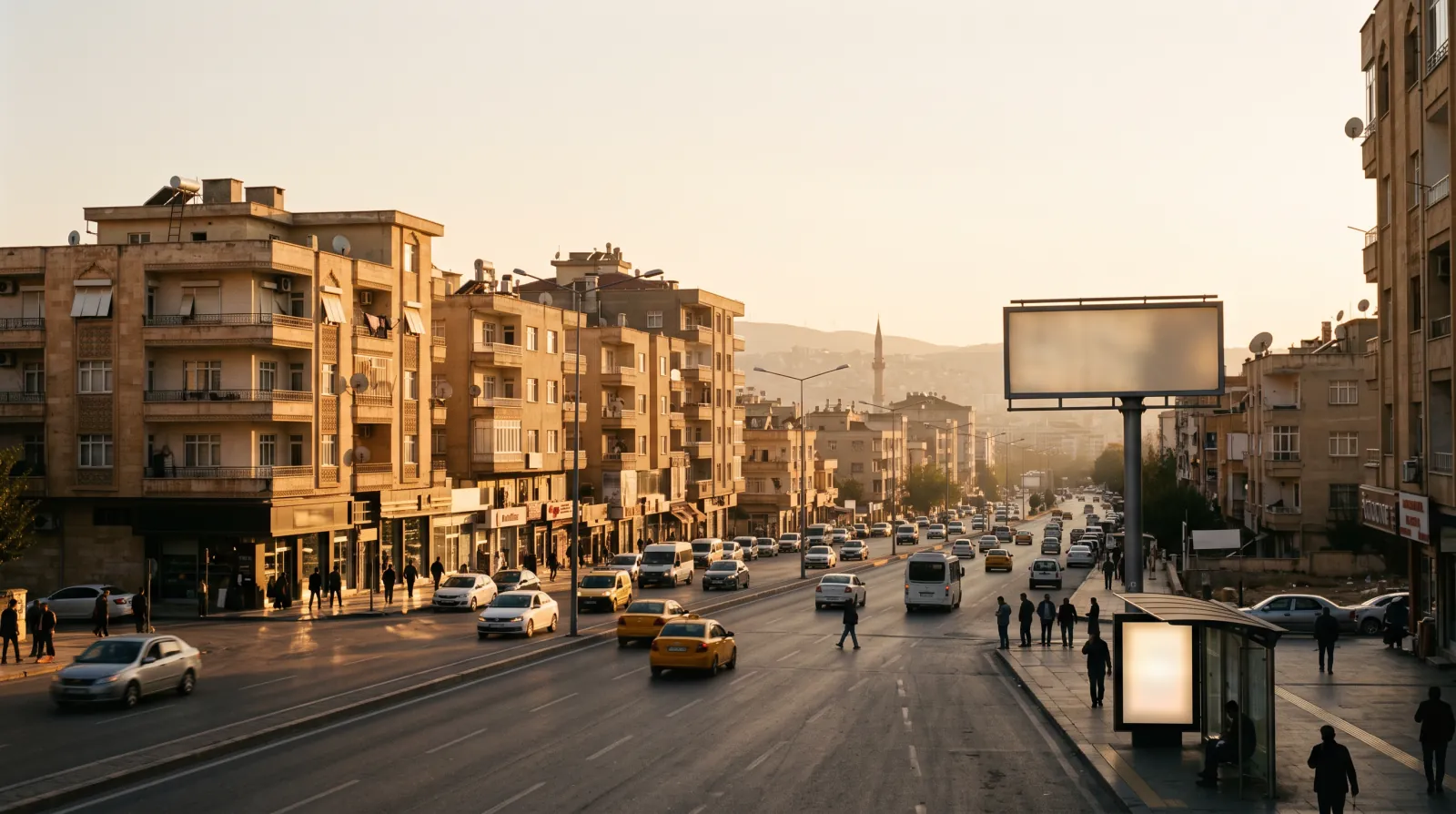
Good results in outdoor advertising in Gaziantep start with choosing the right format: billboards and megalights for fast-moving traffic, street-level panels (CLP) for places with heavy foot traffic, and building wraps for long-term, high-impact visibility. Whichever format you choose, the message has to be readable in a few seconds, which means one idea, few words and strong contrast. The campaign itself should be planned with location, duration and the other channels in mind.
In this guide, drawing on our work in Gaziantep since 2007, we have gathered the questions to ask and the practical points to watch when deciding on outdoor advertising.
Why is outdoor advertising still a strong channel in Gaziantep?
Gaziantep is a city with heavy daily traffic between its industrial zones and the city centre, fast-growing residential developments, and a business culture that still runs largely on face-to-face relationships. In a city like this, outdoor advertising reaches people right inside their daily routine: on the way to work, out shopping, coming home from school.
What sets it apart from digital advertising is that it cannot be closed or skipped. But that advantage alone is not enough. A panel in the wrong place, or one that cannot be read, is ineffective no matter how large it is. That is why outdoor advertising is not a matter of "renting space" but of communication design.
Formats: what is each one good for?
Every outdoor format is seen in its own way. Before choosing, you need to answer one question first: who will see it, from where, and at what speed?
Billboard
The billboard is the classic format aimed at vehicle traffic along main roads and around junctions. Viewing time is short; a driver usually sees the panel for a few seconds. So a single image, a single main message and an easy-to-remember brand signature are enough on a billboard. It suits campaign announcements, new branch openings and brand awareness work.
Street-level panel (CLP)
Backlit street panels, known in Turkey as "raket" or CLP, sit at pavement level, close to eye height. Pedestrians and slow-moving traffic can look at them for longer. This lets them carry a little more information than a billboard, though the message still should not be crowded. In areas with heavy foot traffic, such as the bazaar, shopping streets and around universities, they are an effective option for businesses located nearby.
Megalight
Megalights are large, usually backlit panels. They are highly visible at night and give a strong presence on main arteries. They suit brands that want to reach a wider audience quickly. Because backlighting can make colours look different in print and under light, print proofs and colour checks matter during the design stage.
Building wrap
A building wrap covers a large part of a façade and is a long-term, high-impact application. It is often chosen for construction sites, sales offices, store openings and corporate buildings. The larger the scale, the more important simplicity becomes; windows, projections and viewing angles on the façade should be treated as part of the design. We cover applications in residential projects in detail in our article on building wraps and construction site advertising.
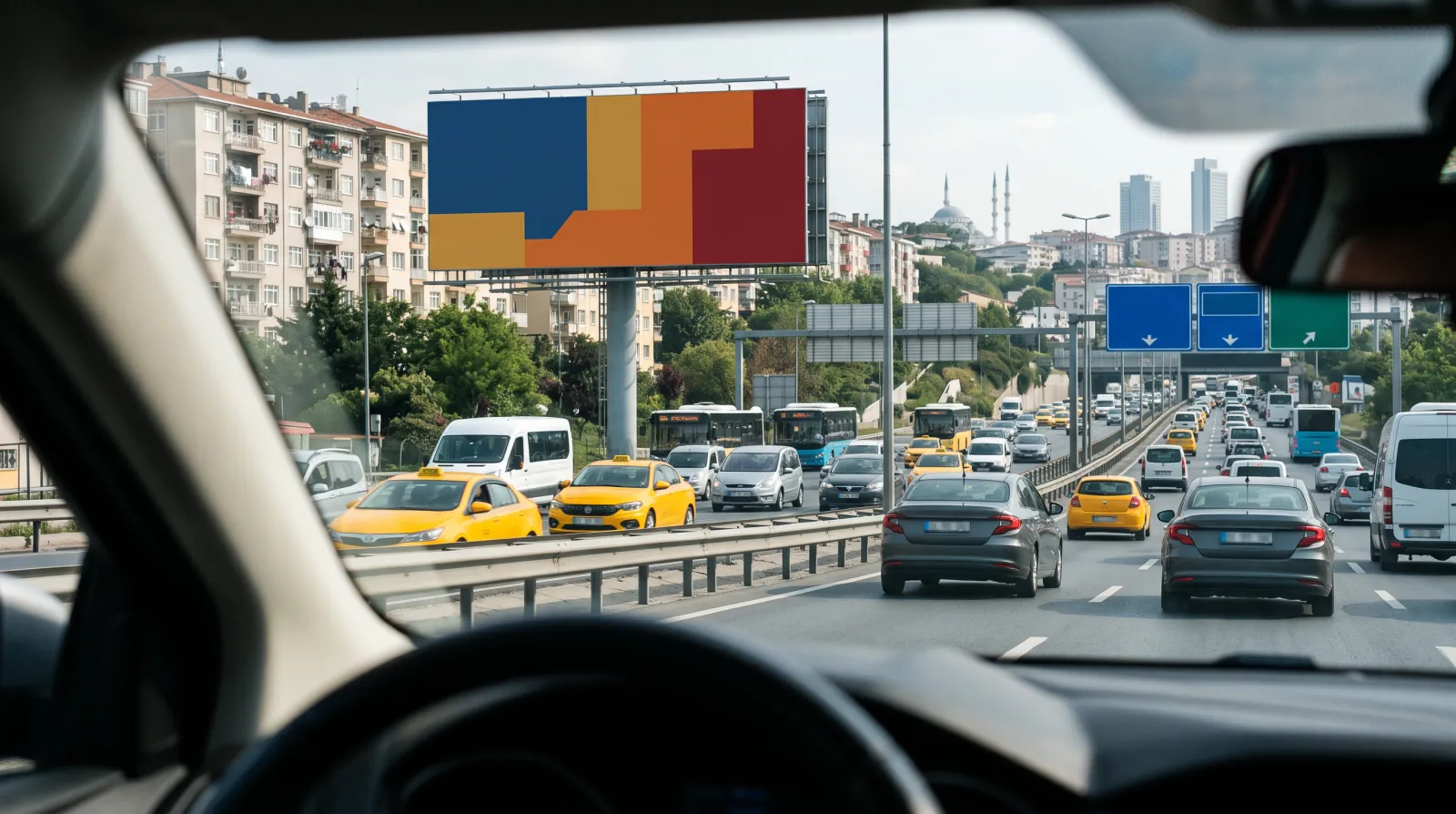
Viewing distance and time: how do you shorten the message?
The basic constraint of outdoor design is time. Viewers do not stop in front of a panel; they pass it. So a design should be judged on the road and in motion, not on a screen in the office.
A practical rule often used in the industry is that the main message should not go much beyond seven words. It is not a strict limit, but it is a good checkpoint. When shortening a message, these questions help:
- What is the single idea? Write down, in one sentence, the one thought the panel should leave with the viewer. If there are two ideas, you need two separate designs.
- Which information is really needed? Long addresses, several phone numbers and product lists are not read outdoors. The brand name, a short message and, if needed, a single call to action are enough.
- Does the image carry the message? A strong product photo or a clear visual is understood faster than a few sentences of explanation. This is where professional photography directly determines the quality of outdoor design.
- Can it be read from a distance? Shrinking the design and looking at it from a few metres back is a simple but effective test. Text that cannot be read on a small screen will not be read on the road either.
Letter size, contrast and typeface choice also determine legibility. Thin, decorative or tightly spaced typefaces break apart at a distance. We explain this in a more technical framework in our sign design and legibility guide.
Core principles of effective outdoor design
- High contrast: Dark text on a light background, or the reverse. Colours of similar tone blend into each other, especially in daylight and at a distance.
- A clear brand signature: The logo and brand colours should be recognised at first glance. If the brand identity is inconsistent, every panel is perceived as a new brand.
- White space: A crowded panel says less than one that uses empty space well. Space lets the message breathe.
- Relationship with the surroundings: Is the panel's backdrop the sky, a building or trees? The surrounding colours affect whether the design gets noticed.
- Night and day: On illuminated formats, the design should be checked both in daylight and under lighting.
Campaign planning: step by step
This is the basic flow we follow when planning an outdoor campaign in Gaziantep:
- Clarify the goal. Awareness, traffic to a new branch, or a campaign announcement? The goal directly shapes the choice of format and message.
- Think about your audience's routes. Which roads does your target audience use? The routes to industrial zones, the city centre, residential areas and campus surroundings reach different audiences.
- Decide on the format mix. Combinations such as using billboards and street panels together, instead of a single large panel, let the same message be seen again at different touchpoints.
- Plan the duration. Outdoor gains strength through repetition and continuity. Very short campaigns may not give the message time to settle.
- Connect it to other channels. The message on the panel should have a counterpart on social media and the website. When social media management and outdoor speak the same language, viewers recognise the brand at every touchpoint.
- Check permits and technical conditions. Especially for permanent installations and building wraps, the relevant municipality's permit procedures and the structure's technical suitability should be checked in advance. The most accurate information on regulations and permits always comes from the relevant municipality.
For example, in our work for No5, a patisserie and café brand, we planned the outdoor applications together with social media and video content. In the Asce project, where we handled the signage for a residential development, the communication was built around visibility in the surroundings of the project site.
Common mistakes
- Moving a brochure onto a panel: Trying to fit the entire content of a printed ad onto a billboard is the most common mistake.
- Choosing locations on price alone: A cheaper panel ends up expensive if your target audience never passes it.
- Neglecting print quality: Low-resolution images fall apart at large scale. Print files should be prepared for the real size.
- Forgetting the panel after the campaign ends: An expired campaign message makes a brand look careless.
Frequently asked questions
Billboard or street panel: which is more effective?
It depends on the goal. Billboards are better for reaching vehicle traffic and a wide audience; street panels suit areas with heavy foot traffic and spots close to your store. In many campaigns, using both together gives the most balanced result.
How long should an outdoor campaign run?
There is no fixed duration, but because outdoor works through repetition, plan for a period in which your target audience can see the message more than once. The goal, the budget and the nature of the campaign together determine the duration.
Does a building wrap require a permit?
Permanent or large-scale installations are generally subject to the relevant municipality's permit procedures. Since requirements can vary by application and location, the right approach is to get information from the municipality before applying.
How much text should I put on a panel?
As little as possible. Keeping the main message to a few words, with the brand name and a single call to action clearly visible, is enough. Details should be left to the website or social media.
When planned properly, outdoor advertising is the channel that shows a brand's presence in the city most concretely. Choosing the format for the audience, shortening the message and planning the campaign together with other channels are the foundations of getting a return on the investment.
If you are planning a campaign in Gaziantep, our outdoor advertising service can take you through the whole process, from choosing formats to design and installation; to take the first step, get in touch with us.