Why Is Everyone Looking for a UX Designer?
"UX designer" has become one of the most frequently heard titles in the technology industry over the past few years. In LinkedIn job listings, in the founding teams of startups, in the digital transformation programs of large banks, the same role keeps coming up: UX designer. But why? Because the success of a digital product no longer rests on its technology or its looks alone. User experience (UX), the relationship a product builds with the person using it, is rewriting the rules of the game.
An app can be fast and still lose people to confusing menus. A website can look sharp and still watch conversions collapse because the shopping cart is convoluted. This is exactly where the question "what is a UX designer?" starts to matter. A UX designer is the architect of an experience that is meaningful, easy, enjoyable and efficient for the person on the other side of the screen.
In this article we cover in full detail who the UX designer is, what the job involves, which skills it calls for, how it differs from the UI designer, and why it plays such a critical role in today's digital products.
What Is a UX Designer?
The term "UX" was first coined in the 1990s by Donald Norman. While working at Apple, Norman argued that products had to be not only functional but genuinely easy for people to use, and he introduced the concept of "user experience" to the field.
Put simply, a UX designer is the person who designs every point at which a product meets its user. That is not screen design alone; it is a journey. From the moment someone downloads an app to the moment they finish a purchase and reach out to the support team, the whole process is an "experience".
The UX designer's job is to make that journey as smooth, as clear and as enjoyable as it can be. A UX designer is, in essence, an experience architect who raises the usability and accessibility of a product.
What Does a UX Designer Do?
A UX designer's work covers very broad ground. The role shapes not just the "look" of a product, but the way it fundamentally works.
1. User Research
Everything starts with understanding people. A UX designer investigates the behavior, needs and expectations of the target audience. The methods for this include:
- Surveys
- In-depth interviews
- Observation studies
- Usability testing
and similar forms of user research.
Any design produced without research is a journey taken in the dark.
2. User Flows and Information Architecture
When someone opens an app, where do they tap and which steps do they follow? The answer to those questions is the "user flow". A UX designer maps that flow and builds the information architecture so that nothing feels complicated to the user.
Take the money transfer process in a fintech app:
- The user signs in
- Selects an account
- Enters the recipient's details
- Arrives at the confirmation screen
Every step has to be clear, simple and consistent.
3. Building Wireframes and Prototypes
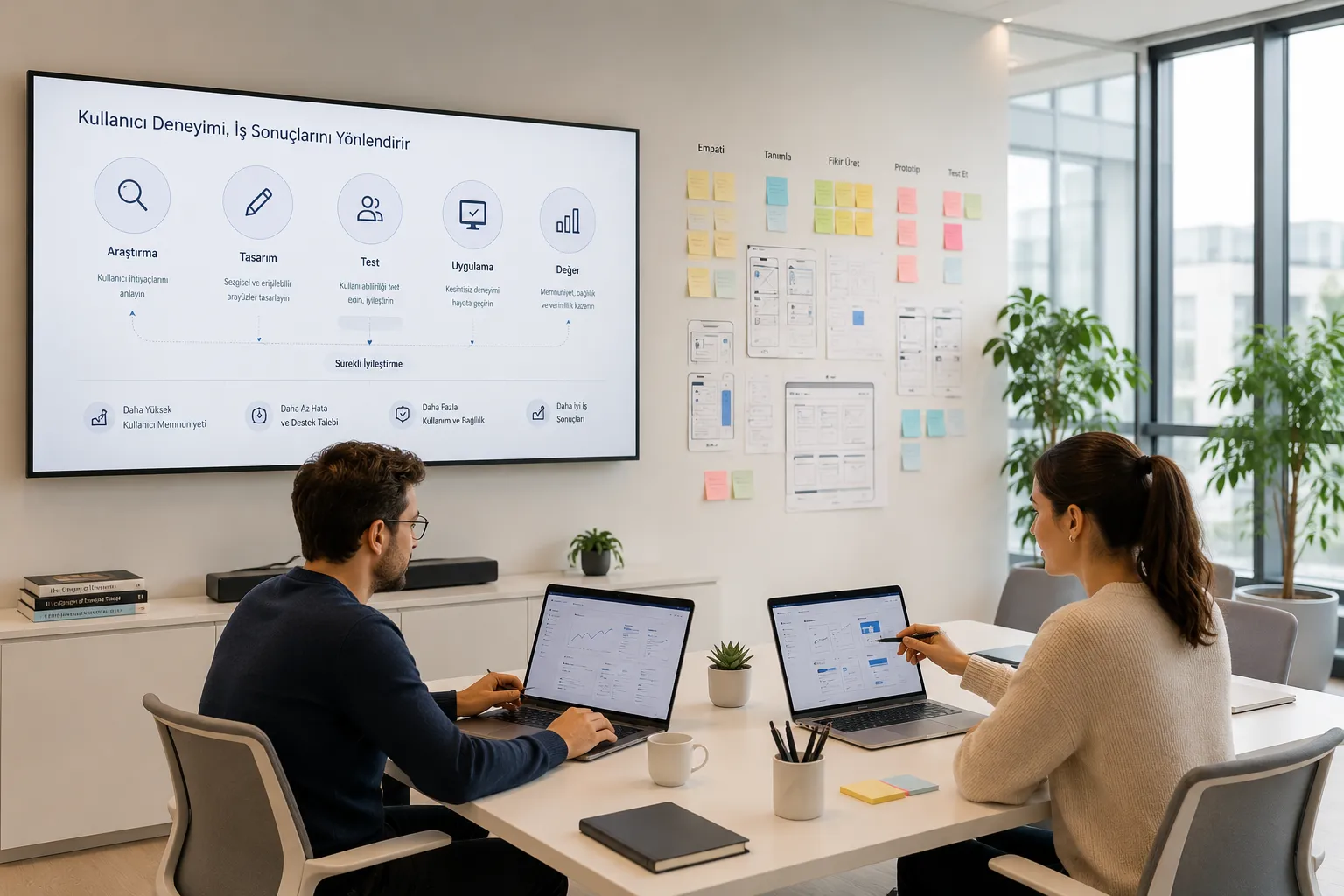
A UX designer makes ideas visible. That means rough screen sketches, or wireframes, and clickable prototypes. Teams and stakeholders can then experience the product before a single line of it is built.
4. Testing and Iteration
UX design is not a "do it once and you are finished" discipline. Usability testing is run, feedback is collected and improvements keep coming. That loop of iteration is one of the most critical parts of a UX designer's job.
A UX Designer's Areas of Responsibility
A UX designer's contribution is never confined to a single field.
- Mobile apps: Banking, e-commerce, gaming…
- Websites: Accessible, user-friendly, conversion-focused.
- SaaS products: Simplifying complex dashboards.
- Fintech solutions: Security, speed and transparency first.
In financial technology in particular, UX plays a critical part in earning user trust; a single moment of ambiguity in a flow is enough to make someone abandon a transaction halfway through.
The Skills You Need to Become a UX Designer
1. Research Ability
Understanding the user, observing behavior, asking the right questions.
2. Empathy
Putting the user's real needs at the center rather than your own assumptions.
3. Analytical Thinking
Working with data and analyzing the results that come out of usability testing.
4. Command of the Tools
Fluency in design tools such as Figma, Sketch, Adobe XD and Miro.
5. Communication and Teamwork
A UX designer never works alone. The role stays in constant contact with developers, UI designers, product managers and business teams.
The Difference Between a UX Designer and a UI Designer
The two concepts people mix up most often: UX and UI.
- UX designer: Designs the user's journey through the product.
- UI designer: Designs the visual surface of that journey.
A simple example:
Picture a coffee app.
- The UX designer works out the steps that make ordering a coffee effortless.
- The UI designer chooses the button color, the typography and the imagery.
When the two work together, the product ends up both functional and beautiful.
Why Does a UX Designer Matter?
A UX designer's contribution is measurable:
- Higher customer satisfaction → people reach their goal easily, so they come back to the product again and again.
- Lower support cost → a well-designed product takes weight off the customer service team.
- Higher conversion rate → fewer abandoned e-commerce carts, more completed transactions in a fintech app.
- Brand credibility → A user-friendly experience makes a brand look professional and trustworthy.
The Career Path: How Do You Become a UX Designer?
A roadmap for anyone who wants to move forward in this field:
- Education: A background in design, psychology or human-computer interaction gives you an advantage.
- Courses & bootcamps: General Assembly, the Google UX Certificate, local UX bootcamps.
Career Levels:
- Junior UX Designer → learning the fundamentals
- Mid-level UX Designer → taking ownership on projects
- Senior UX Designer → setting the strategy
- Lead UX Designer → leading the team
In Turkey, demand for the role is climbing fast at fintech, SaaS and e-commerce companies. Globally, and especially across Europe and the United States, "remote UX designer" positions open up serious opportunities.
The UX Designer Is the Key Role of the Future
The success of a digital product is no longer bound by technology alone; any venture built without user experience at its center carries risk. That is why the UX designer has become an indispensable role at every company.
At Derin Fikirler, we put user experience at the center of the process in our branding and digital design work: how an interface looks matters to us, and so does how quickly it gets the user to their goal.
If you would like to improve the user experience of your product or website with a professional team, get in touch with us. Because good UX design moves more than the user forward — it moves your business forward too.