

From the outside, digital product design usually looks like a linear, orderly and clearly defined process. A need emerges, the design is made, it gets built, and it reaches the user. In reality, though, the process is never as clean or as predictable as the theory suggests. Design is not simply a production process in which aesthetic decisions are made; it is a strategic discipline that demands constant balancing between constraints, assumptions, expectations and actual user behavior. In this article we look at three fundamental realities we run into again and again in digital product design, and at how we keep making user-centered decisions inside them.
The Visible and Invisible Sides of the Design Process
On paper, a design process is straightforward. A request comes in, the designer analyzes it, produces a solution, revisions are made, and the work is eventually handed over to development. In practice it is far messier than that. A designer is not just the person who visualizes a request. They are also the person who questions whether that request is the right one, whether it solves the real problem and, most importantly, whether it creates meaningful value for the user.
Because every design process involves four parties:
- The person or organization bringing the request
- The team that defines the need
- The team that does the design
- And most importantly, the user who will actually use the product
The expectations of these four parties do not line up on their own. The design process is the work of bringing them into alignment.

In Real Life, the Design Process Is Never Linear
Digital product design rarely starts with a clear, complete brief. Sometimes there is detailed documentation; sometimes there is only an idea, or a target someone wants to hit. Occasionally even the problem itself is still unclear, long before any solution is. That is why the first step of a design process is not producing an interface but understanding the problem properly. A solid product is built on a well-defined problem. And none of this moves in a straight line. Decisions are constantly revisited in light of feedback, technical constraints and new insights. Design is not a one-pass production job; it is a discovery process that improves through learning and iteration.
Three Big Realities That Shape Design Decisions
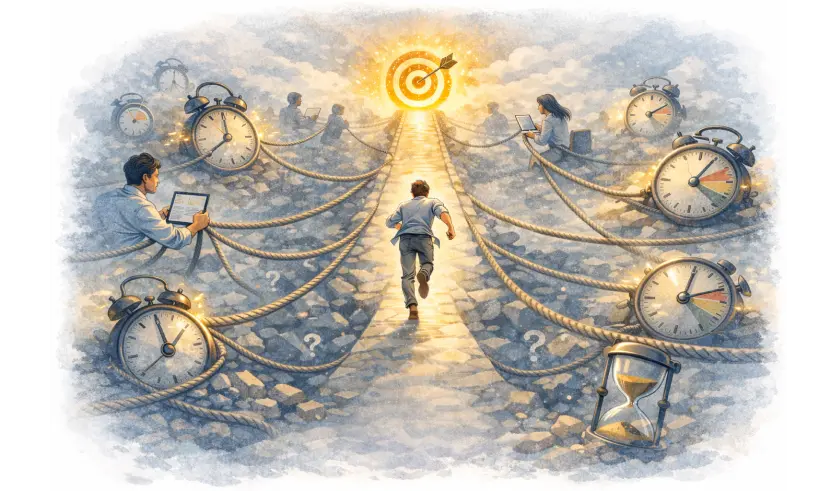
In digital product design, decisions are not always made on user experience grounds alone. More often than not, three factors shape the process directly:
- Budget
- Time
- HIPPO (Organizational Hierarchy)
These factors are an unavoidable part of the design process.
Budget: The Invisible Boundary Around Design
A design solution may offer the best possible experience for the user. Yet the cost of building it has a direct bearing on whether it can be built at all. This is where a designer's job is not only to produce a solution but to make the case for its value. Talking about what a design decision costs matters, and so does spelling out the opportunity cost of not making it. For example:
- Churn rate
- Abandoned transactions
- Declining conversion rates
Metrics like these make the business impact of design decisions concrete. That framing is what positions design as an investment rather than a cost.
Time: The Heaviest Pressure on Design
Time pressure is one of the most common constraints in digital product design. Looming deadlines often push designers to implement a request as fast as it arrives. But the purpose of design is not merely to ship on time; it is to solve the right problem in the right way. The critical skill here is not squeezing the schedule but scoping the work correctly. Instead of trying to solve everything at once, we define the Minimum Viable Product (MVP) that delivers the highest user value. That approach sharpens focus and lets the product evolve iteratively on real user feedback. We also do not try to solve every problem from scratch. Benchmark analysis, products that have already tackled similar problems and established industry standards give us a strong reference point. In recent years AI tools have become a significant accelerator here too, particularly for producing first drafts and weighing alternatives quickly. What matters, as Parkinson's Law reminds us, is not stretching the timeline but focusing on the right thing. Being fast does not have to mean being shallow. Working with the right scope lets us make decisions that are both quicker and better.

The HIPPO Effect: Does Data Decide, or Does Seniority?
In digital product design, decisions are not always made on the basis of data, user needs or product strategy. Sometimes what sets the direction is the personal preference of the most senior person in the room. The literature calls this HIPPO, the Highest Paid Person's Opinion. The HIPPO effect means an idea takes priority because of the position of the person voicing it, regardless of whether it is the right call. Sometimes that shows up in something as small as a color choice; sometimes it turns into far bigger decisions that reshape the product's flow or its experience. In situations like these, a designer's role is not to push back head-on but to move the decision onto firmer ground. The first step is showing that we have understood the other person's idea and that we value it, because a design process is not only about finding the right answer; it is also about building trust and collaboration. The next step is lifting the decision out of personal preference and placing it in a user-centered frame. User behavior, benchmark examples, test results and hard data all make design decisions more objective. That is how a decision stops being an opinion and becomes the right solution for the user. The goal is never to reject an idea; it is to build common ground where every stakeholder can reach the best decision for the product and the user. Because strong products are shaped by user realities, not by personal preferences.

Design's Most Critical Component: Storytelling
There is one thing in the design process that matters just as much as producing a solution: being able to explain it well. Even the best design cannot carry its value across if the design rationale behind it is not communicated clearly. Every presentation we give as designers is, in effect, an act of persuasion. We have to explain not only what we designed but why we designed it that way. Unless we can show which problem it solves, what value it creates for the user and why it is a better answer than the alternatives, the design stays nothing more than an opinion. Strong designs earn buy-in not only by being the right solution, but by telling the story behind that solution well.
Design's Real Owner: The User
Plenty of stakeholders take part in a design process. Product teams, executives, business goals and technical constraints all influence design decisions. At the end of all of it, though, design's real owner is always the user. As Don Norman has pointed out, what matters is not how we want users to behave but how they actually behave. Alan Cooper's approach supports the same point plainly: the user is the product's final decision maker. The purpose of design, then, is not simply to deliver whatever was requested. The real purpose is to understand user behavior and build the right experience from it. Good design is not design made "because someone asked for it"; it is design whose rightness for the user is clearly grounded. Because strong digital products are built on user realities, not on assumptions.